


How is noise at Queenstown Airport governed?
Rules governing noise from Queenstown Airport are set out in the Queenstown Lakes District Plan, which includes hours of operation for the airport, noise boundaries, and how compliance is to be managed.
What are noise boundaries?
A noise boundary is a planning tool to manage and control the impact of aircraft noise on surrounding communities. Queenstown Airport has two compliance noise boundaries that are defined in the Queenstown Lakes District Plan under the Resource Management Act.
How is airport noise measured?
Airport noise is measured using a standard called dB-Ldn (decibels day-night average sound level), which reflects the average noise level over a 24-hour period.
What are Queenstown Airport's noise boundaries?
The airport has three noise boundaries, two of which are compliance boundaries:
The Air Noise Boundary (ANB), also known as the inner zone, where aircraft noise exceeds 65 dB-Ldn. To protect people living and working around the airport, as well as airport operations, any new activity sensitive to aircraft noise, such as residential accommodation, is generally prohibited in this area.
The Mid Noise Boundary, where average aircraft noise is between 60 and 65 dB-Ldn. This is not a compliance boundary but is used as a tool to manage land use and to define part of Queenstown Airport’s noise mitigation programme.
The Outer Control Boundary (OCB), where average aircraft noise is between 55 and 60 dB-Ldn.
How is activity sensitive to aircraft noise defined?
The Queenstown Lakes District Plan defines activity sensitive to aircraft noise (ASAN) as “any residential activity, visitor accommodation activity, homestay activity and day care facility activity, as defined in this District Plan, including all outdoor spaces associated with any education activity, but excludes activity in police stations, fire stations, courthouses, probation and detention centres, government and local government offices”.
How are the noise boundaries calculated?
The boundaries are a calculation of the average noise over a 24-hour period (dB-Ldn) based on the busiest three consecutive months of a calendar year. At Queenstown Airport, these are typically January, February and March.
What are the noise limits for aircraft operations at Queenstown Airport?
There are two compliance contours – the inner Air Noise Boundary (ANB) and the Outer Control Boundary (OCB).
Noise must not exceed 65 dB-Ldn beyond the ANB.
Noise must not exceed 55 dB-Ldn beyond the OCB.
The airport must produce Annual Aircraft Noise Contours (AANC), Compliance Annual Aircraft Noise Contours (CAANC), and Projected Annual Aircraft Noise Contours (PAANC) each year.
How is aircraft noise monitored at Queenstown Airport?
Each year, QAC supplies records of all flights for a full year from onsite measurement tools. Marshall Day Acoustics verifies the busiest three months, then models the compliance using an international noise model. Every three years, actual noise is required to be logged and adjustments are made to the noise profiles in the model so that it reports an accurate representation of the noise experienced at and around Queenstown.
How are the results reported?
Every year, a compliance report for the previous calendar year is produced and published. A forecast based on aircraft movement projections for the following year is included.
How does Queenstown Airport manage noise?
Queenstown Airport has a Noise Management Plan for managing and mitigating the effects of aircraft noise on the surrounding communities. The plan can be found here.
What does the Noise Management Plan cover?
The plan covers:
- the composition of the Queenstown Airport Liaison Committee
- noise monitoring
- aircraft engine testing rules
- complaints procedures
- considerate flying practices
- noise mitigation measures
What is the role of the Queenstown Airport Liaison Committee?
The Queenstown Airport Liaison Committee (QALC) was formed in 2013. Its purpose is to act as a forum and interface between the Queenstown Airport Corporation, the community and other stakeholders regarding day-to-day issues related to noise at Queenstown Airport.
Who is on the Queenstown Airport Liaison Committee?
The committee of 11 includes an independent chairperson, four community representatives, a representative of the Queenstown Lakes District Council, a representative of Airways NZ, one airline representative, one general aviation representative and two Queenstown Airport representatives. The current membership is available here.
The community representatives are appointed by QLDC, reflecting the communities closest to the airport: Frankton, Kelvin Heights, Hanleys Farm/Jacks Point, Lake Hayes Estate/Quail Rise/Shotover Country.
How often does the Queenstown Airport Liaison Committee meet?
The committee meets quarterly and is presented with information about noise complaints and queries from residents. It monitors how Queenstown Airport deals with those complaints, aircraft activities, and unplanned engine testing incidents. It also receives the airport's operational report, which includes updates on the Noise Mitigation Programme. The Annual Aircraft Noise Contours are reviewed by the committee.
Did Queenstown Airport achieve compliance in 2025?
A minor noise breach was confirmed south of the crosswind runway within the 2025 calendar year. This was confirmed in May 2026, following completion of the compliance reporting for 2025. The breach related to the Outer Control Boundary, not the inner Air Noise Boundary.
An independent report was tabled at the Queenstown Airport Liaison Committee meeting on 25 May 2026. The Queenstown Airport 2025 Noise Compliance Report is available here.
What is the forecast for the 2026 compliance report?
An interim report was run based on flight data for Queenstown Airport’s typically busiest three months, January, February and March 2026. It is projected that compliance for the 2026 calendar year will be achieved. The 2026 Noise Compliance Report cannot officially be completed until 2027 with a full 12 months of data.
What caused the breach in 2025?
The breach related to both helicopter activity and use of the crosswind runway by small fixed-wing aircraft. Outstanding flying conditions during the 2024-2025 summer contributed to record activity by the flightseeing businesses based at Queenstown Airport.
What about scheduled flights?
Scheduled flights by jets and turboprop aircraft use the main runway, and their activity remains well within the permitted noise boundaries, with capacity available for planned growth.
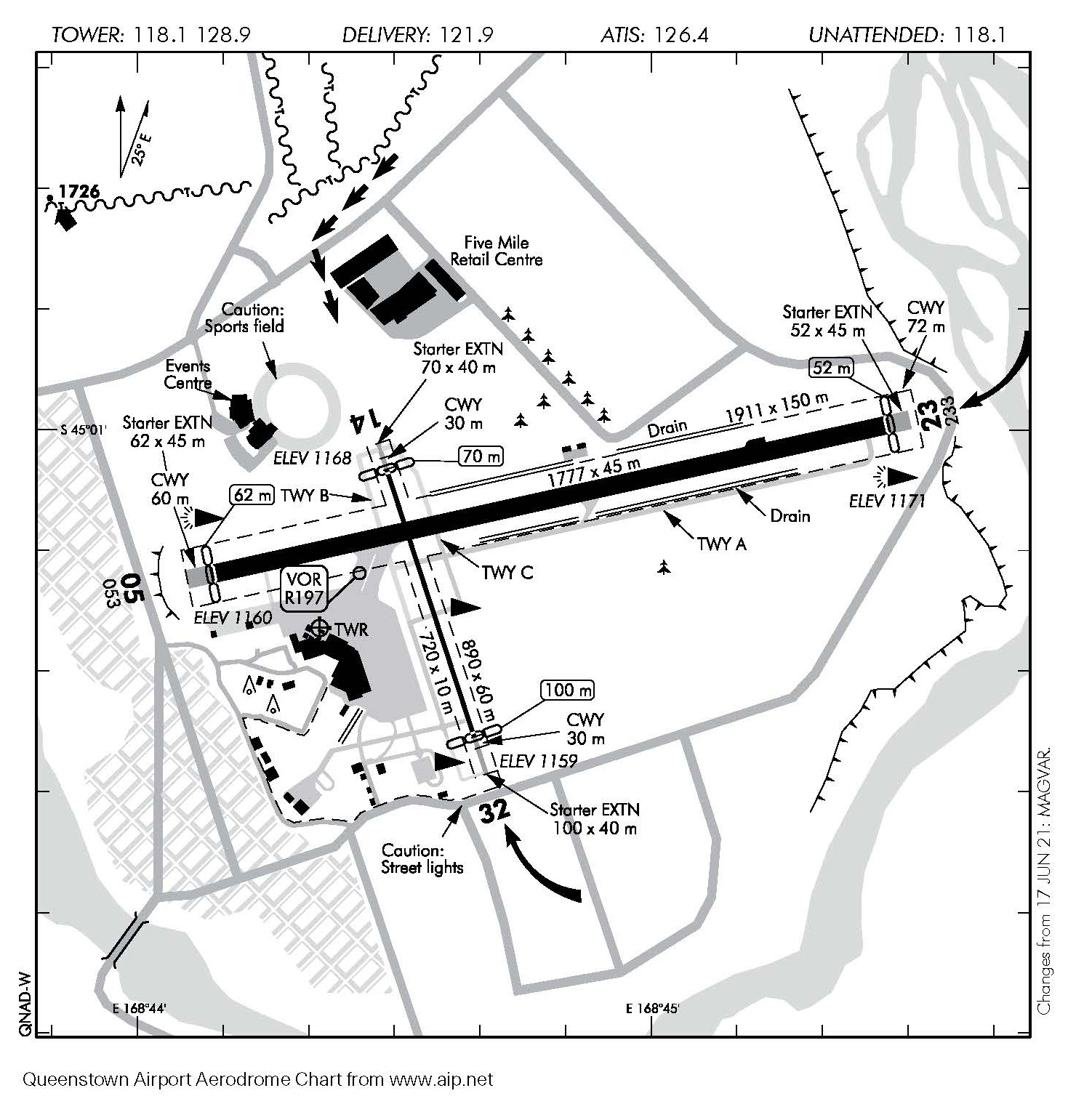
What are the main and crosswind runways at Queenstown Airport?
What did Queenstown Airport do in response to the breach in 2025?
Immediate steps were taken to ensure this does not happen again. Queenstown Airport worked closely with general aviation operators and Airways, which manages air traffic, to reduce the use of the crosswind runway. In simple terms, about four small fixed-wing flights a day during peak season needed to be moved from the crosswind runway to the main runway to achieve future compliance.
Why do small aircraft use the crosswind runway?
Small aircraft use the crosswind runway to assist with the throughput of the airfield and as required based on wind conditions. The main runway has comparatively low utilisation because without a taxiway the larger aircraft occupy the runway for extended periods as they taxi on it for departure and after arrival. The crosswind runway helps alleviate this constraint. However, a heavy taxiway is under construction and once this is complete, small aircraft are likely to use the main runway more often.
How did the changes affect general aviation businesses?
Some flights were allocated to the main runway rather than the crosswind runway during quieter periods of the day. Queenstown Airport's general aviation operators are well accustomed to using the main runway, so this was not a major change to the way they operate.
How was the 2025 breach reported?
As soon as it was known that a breach was projected for the 2025 calendar year, QAC informed the Queenstown Airport Liaison Committee. It also directly informed the Queenstown Lakes District Council and other stakeholders, such as residents’ associations close to the airport. Compliance reporting for the 2025 calendar year was completed in March 2026, after which QAC formally notified QALC and QLDC that the breach had been confirmed. QAC prepared a report for the Queenstown Airport Liaison Committee detailing the cause of the breach and the actions taken to ensure this does not occur again.
What are the next steps for reporting?
The next compliance reporting for calendar year 2026 will be completed in early 2027. QAC requested that an interim compliance check was undertaken at the end of Queenstown Airport’s typically busiest three-month period, January, February, and March. This compliance check confirmed that the mitigation measures we put in place following the 2025 breach were effective and that compliance is projected to be achieved for 2026.